
3D printing isn’t new anymore.
But the way it’s being used today…that’s where things get interesting.
Across industries, it’s no longer just about prototypes or small models. It’s becoming part of real production, real businesses, real problems being solved. Especially when you look at 3D printing applications in Egypt, you start to see how practical it has become.
Here are 10 ways in which 3D printing is changing industries:
1. Faster Prototyping
Designing something used to take time. Weeks, sometimes months.
With 3D printing being used in manufacturing, prototypes can be created in hours. Engineers test, adjust, and improve without waiting. It speeds up decision making and reduces mistakes early on.
2. Custom Manufacturing
Not everything needs to be mass produced.
3D printing allows businesses to create customized parts based on specific needs. This is especially useful in industries where one-size-fits-all doesn’t work.
3. Reduced Production Costs
Traditional manufacturing often involves molds, tooling, and setup costs.
With industrial 3D printing, many of these steps are removed. Less material waste. Fewer processes. Lower overall cost, especially for small to medium production runs.
4. Complex Designs Made Simple
Some designs are just too complicated for traditional methods.
3D printing handles complexity easily. Internal structures, lightweight geometries, and intricate details can be produced without extra effort.
5. Spare Parts On Demand
Instead of storing large inventories, companies can print parts when needed.
This is one of the most practical 3D printing applications, especially for maintenance and repair industries.
6. Healthcare Advancements
From dental models to prosthetics, 3D printing is changing healthcare.
Doctors can now create patient-specific solutions quickly. It improves accuracy and reduces waiting time for patients.
7. Construction and Architecture
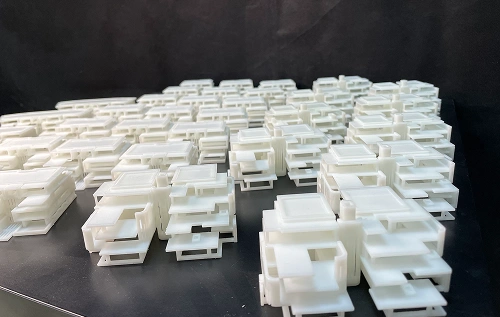
Architects are using 3D printing for detailed models.
In some cases, even building components are being printed. It allows better visualization and more precise planning before construction begins.
8. Automotive and Engineering
The automotive industry uses 3D printing for prototyping and even end-use parts.
Engineers can test designs quickly and optimize performance without long production cycles.
9. Education and Learning
Students understand concepts better when they can see and hold them.
Universities and training institutes in Egypt are adopting 3D printing to make learning more practical, especially in engineering and design fields.
10. Small Business Innovation
3D printing lowers the barrier to entry.
Small businesses can create products without investing in large factories. This is where industrial 3D printing is opening new opportunities for startups and entrepreneurs.
Conclusion
3D printing is not replacing traditional manufacturing.
It’s improving it. Making it faster, more flexible, and more accessible.
From engineering to healthcare to small businesses, the shift is already happening. And as 3D printing continue to grow, the focus is becoming clear in practical use, real value, and smarter production.
FAQ’s
- Q) Is 3D printing suitable for small businesses in Egypt?
One of the biggest advantages of 3D printing applications in Egypt is accessibility. Small businesses can create products, prototypes, and custom items without heavy investment in machinery or factories. - Q) What are the most common 3D printing applications in Egypt?
Some of the most practical 3D printing applications in Egypt include prototyping, spare parts production, medical models, architectural designs, and small-scale manufacturing. These uses are growing as businesses look for faster and more flexible solutions. - Q) Which industries benefit the most from 3D printing?
Industries like healthcare, automotive, architecture, construction, education, and product design benefit the most. In Egypt, these sectors are actively exploring industrial 3D printing to improve efficiency and innovation.