
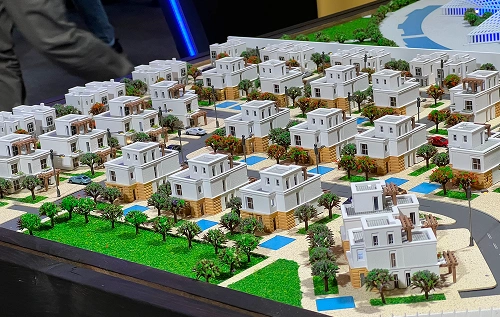
A rendered image on a screen still asks people to imagine. A physical model in front of them doesn’t.
That gap, between imagining a building and actually seeing it, is exactly why physical scale models never went away, even as 3D renders got better. What’s changed is how those models get made. Architectural 3D models in Egypt used to mean weeks of hand-cutting foam and balsa wood. Now, 3D printing produces the same model, often better detailed, in a fraction of the time.
Why Physical Models Still Win Over Renders
A drawing asks someone to interpret it. A model just shows them.
Planning committees can walk around a physical model and judge how a new building actually sits against its neighbors, something a 2D elevation drawing can’t communicate. Investors evaluating a mixed-use development respond differently to holding a scaled version of it than scrolling through renders on a laptop. That’s not nostalgia for old-school model-making. It’s a real difference in how people process spatial information.
It’s not about physical models replacing digital visualization. It’s about the two doing different jobs, one explains the concept, the other lets someone actually experience the scale.
What 3D Printing Actually Changes
The technology didn’t create a new category. It fixed the old one’s biggest weaknesses.
- Cost: typically 30-60% less than handmade models
- Turnaround: days instead of weeks
- Precision: micron-level facade and texture detail
- Scale flexibility: 1:500 master plans up to 1:100 marketing models
- Consistency: no manual variation between identical units
Traditional hand-built models demanded skilled labor and a long lead time, both of which get expensive fast on a tight project timeline. Converting a CAD or BIM file directly into a printed model skips that bottleneck almost entirely, while actually improving detail accuracy on complex facades and geometry that used to be nearly impossible to replicate by hand.
Why You Should Choose Gazelle 3D
This is precisely the shift Gazelle 3D was built around, in 6th of October City, Giza.
Backed by what the company describes as Egypt’s largest 3D printing facility, Gazelle 3D handles the entire process end-to-end, with one point of contact instead of coordinating separate designers, printers, and finishers. That matters for architectural 3D models in Egypt specifically, where deadlines tied to investor pitches or planning submissions rarely leave room for delays.
Client feedback reflects that directly, from architects needing polished presentation pieces to students and freelance designers needing fast turnaround without sacrificing detail. Models ship both within Egypt and internationally, built around each client’s scale, budget, and timeline.
FAQs
Q1) Why choose a 3D printed model over a traditional handmade one?
3D printed models are typically 30-60% cheaper, produced in days rather than weeks, and achieve finer facade and texture detail.
Q2) What scale is best for an investor presentation model?
1:200 is common for planning and investor presentations, while 1:100 suits detailed marketing suite displays.
Q3) Can 3D printed models be produced from existing CAD or BIM files?
Yes. Digital design files convert directly into printable model data, keeping dimensions accurate to the original drawings.
Q4) Do physical models still matter next to digital renders?
Yes. Physical models help audiences judge scale, height, and spatial relationships in ways 2D renders and screens can’t fully convey.
Q5) Where can I get high-precision architectural 3D models in Egypt?
Gazelle 3D produces architectural 3D models in Egypt using advanced 3D printing, backed by one of the country’s largest printing facilities.
Conclusion
A rendering explains a building. A model lets someone stand over it and understand it instantly.
3D printing didn’t change why that matters. It just made getting there faster, cheaper, and a lot more precise.
That’s the whole shift behind architectural 3D models in Egypt right now.